 ultimate-guide
Can Grandparents Get Custody or Visitation Rights in Maryland?
Last Updated: October 25, 2026
Quick Summary
Grandparents custody visitation in Maryland does not occur automatically; grandparents must file a petition with the court and demonstrate that visitation or custody serves the child's best interests and meets legal standards. Courts begin with a presumption that fit parents' decisions about their children are in the child's best interests, and grandparents must present clear and convincing evidence to overcome this parental presumption.
- Grandparents are considered third parties under Maryland law and cannot demand visitation or custody based solely on biological relationship.
- Grandparent visitation is governed by Maryland Code, Family Law Section 9-102, which requires demonstrating the child's best interests.
- Grandparent custody requires proving exceptional circumstances exist, such as parental death, incarceration, abuse, neglect, or abandonment.
- You must serve the child's parents with your petition and they have 30 days to file a response.
- Courts examine factors including relationship quality, the child's preference, impact on the parent-child relationship, and any history of abuse or neglect.
Table of Contents
- Do Grandparents Have Legal Rights to Visitation in Maryland?
- Understanding Maryland Grandparents Visitation Rights
- Can Grandparents Seek Custody or Third-Party Custody in Maryland?
- How to File a Grandparent Visitation Petition in Maryland
- What Courts Consider: The Best Interests Standard and Parental Presumption
- Maryland Grandparent Custody Rights and Exceptional Circumstances
- Evidence and Preparation for a Contested Petition
- Next Steps: Getting Legal Guidance for Your Situation
- Frequently Asked Questions
Do Grandparents Have Legal Rights to Visitation in Maryland?
Grandparents custody visitation in Maryland does not occur automatically; grandparents do not have the right to visit or have custody of their grandchildren without court intervention.
The key distinction is that grandparents are considered "third parties" under Maryland law. This means you cannot simply demand visitation or custody based on your biological relationship to your grandchild.
At The Law Office of Thomas K. Mallon, LLC, we help grandparents navigate these complex family law matters with clarity and compassion.
Understanding Maryland Grandparents Visitation Rights
Grandparent visitation rights in Maryland are governed by Maryland Code, Family Law Section 9-102. This statute allows grandparents to petition the court for reasonable visitation with their grandchildren, but only under specific circumstances.
To petition for visitation, you must demonstrate that visitation is in the best interests of the child. This is a higher standard than simply wanting to see your grandchild.
One critical point: if the child's parents are married and fit, courts begin with a presumption that their decisions regarding grandparent contact serve the child's best interests. This parental presumption is a constitutional protection.
Can Grandparents Seek Custody or Third-Party Custody in Maryland?
Yes, grandparents can seek custody of their grandchildren, but the legal pathway differs from visitation.
Maryland law recognizes two types of custody that may be relevant to grandparents: legal custody (the right to make major decisions about the child's upbringing) and physical custody (where the child lives). Grandparents typically pursue physical custody when parents are unable or unfit to care for the child.
The standard for third-party custody, which includes grandparent custody, is stricter than for visitation. You must prove that custody serves the child's best interests and that exceptional circumstances exist.
Courts do not award custody to grandparents simply because it might be convenient or because the grandparent has a strong relationship with the child. The focus remains on what is genuinely best for the child's safety, stability, and development.
How to File a Grandparent Visitation Petition in Maryland
Where to File and What Forms You Need
Filing a grandparent visitation petition in Maryland requires you to submit documents to the appropriate court in the jurisdiction where the child resides. Learn the step-by-step process for filing for child custody, which applies to grandparent petitions as well.
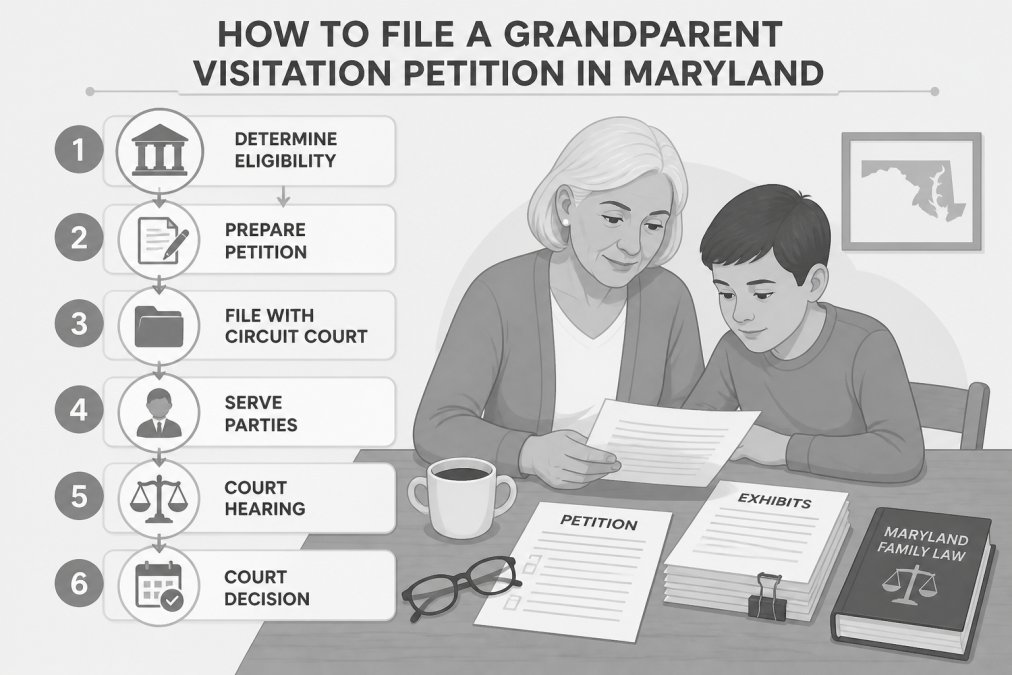
The petition itself is a formal legal document that sets out your request for visitation and the reasons you believe it serves the child's best interests. You will need to complete the petition form specific to your situation.
Your petition should include:
- Your name, address, and relationship to the child
- The child's name and date of birth
- The names and addresses of the child's parents or current custodians
- A clear statement of what visitation arrangement you are requesting
- Factual details about your relationship with the child and why visitation is in their best interests
- Any relevant circumstances, such as the death of a parent or a parent's incapacity
You will also need to file a Domestic Relations Information Report, which provides background information to the court. Filing fees apply, though if you cannot afford them, you may request a fee waiver for custody court costs.
Service Requirements and Timelines
Once your petition is filed, you must serve copies on the child's parents or custodians. Service means formally delivering the documents according to Maryland legal procedures.
Service can be accomplished by certified mail, personal delivery by a sheriff or process server, or other methods approved by the court.
After service, the parents have a set time to respond. The timeline typically allows them 30 days to file their response.
The overall timeline from filing to hearing varies depending on court schedules and whether the case is contested. For guidance on what to expect in your specific situation, consider reviewing our step-by-step custody timeline guide or consulting with a family law attorney.
What Courts Consider: The Best Interests Standard and Parental Presumption
The best interests of the child is the standard courts apply in all custody and visitation cases.
To overcome this presumption, you must present clear and convincing evidence, a high legal standard, that demonstrates why the child's best interests require court intervention.
Schedule Your Free Consultation →
Courts consider several factors when evaluating a grandparent visitation petition:
- The length and quality of your relationship with the grandchild
- The grandchild's preference, if they are old enough to express one
- The impact of visitation on the child's relationship with their parents
- The child's adjustment to home, school, and community
- The physical and mental health of all parties involved
- Any history of abuse, neglect, or substance abuse
The parental presumption reflects the constitutional protection parents have to direct the upbringing of their children. Courts recognize that parents, not grandparents or other third parties, have the primary right to make decisions about their children.
Maryland courts evaluate grandparent visitation petitions by examining specific factors about the child and family circumstances.
| Factor | What Courts Examine |
|---|---|
| Relationship quality | Length and quality of grandparent-grandchild relationship |
| Child's preference | Grandchild's preference if old enough to express one |
| Parental impact | Impact of visitation on child's relationship with parents |
| Child's adjustment | Child's adjustment to home, school, and community |
| Health and wellbeing | Physical and mental health of all parties involved |
| History of harm | Any history of abuse, neglect, or substance abuse |
Maryland Grandparent Custody Rights and Exceptional Circumstances
Grandparent custody in Maryland is available only when exceptional circumstances exist. These are circumstances beyond the ordinary situations that arise in family life.
Courts distinguish between situations where grandparents simply want more involvement in the child's life and situations where the child's welfare is genuinely at risk without grandparent custody.
If you are seeking custody because one parent has died, the surviving parent generally retains custody unless they are unfit.
The legal rights of grandparents in Maryland custody cases are therefore limited but real.
Evidence and Preparation for a Contested Petition
If the parents object to your petition, which is common, you will need to prepare evidence to present to the court.
Gather documentation that demonstrates your relationship with the grandchild and supports your position. This might include:
- Photographs and videos showing you with the grandchild over time
- Birthday cards, letters, or other written communication
- School records or medical records showing your involvement
- Financial records if you have provided financial support
- Testimony from teachers, coaches, or others who can speak to the child's relationship with you
- Evidence of any parental unfitness or exceptional circumstances (medical records, police reports, court documents)
Witnesses can be powerful. Teachers, counselors, neighbors, or other family members who can testify about your relationship with the child and the child's welfare carry significant weight.
You should also be prepared to explain why visitation or custody serves the child's best interests.
Next Steps: Getting Legal Guidance for Your Situation
Navigating grandparents custody visitation in Maryland is complex, and the stakes are high.
The Law Office of Thomas K. Mallon, LLC has more than 25 years of experience helping families in Maryland address custody and visitation matters. We understand both the legal requirements and the emotional complexity of these situations.
The emotional weight of being separated from your grandchild is real, and the legal system can feel overwhelming. You do not have to navigate it alone. Schedule your free consultation with The Law Office of Thomas K.
Frequently Asked Questions
What are the legal rights of grandparents in Maryland custody and visitation cases?
In Maryland, grandparents do not have an automatic right to visitation or custody. However, they may petition a court for reasonable visitation if they can show exceptional circumstances, such as parental death, abandonment, or unfitness, and that visitation serves the child's best interests. The law recognizes that fit parents have a fundamental right to raise their children, so grandparents must overcome this parental presumption through evidence. Courts examine factors including the child's relationship with the grandparent, the child's welfare, and whether the arrangement is reasonable.
Can grandparents petition for visitation if a parent refuses contact in Maryland?
Yes, grandparents can file a petition for visitation even if a parent objects. However, parental objection creates a significant legal hurdle. Under Maryland law, a parent's refusal alone is not enough to grant visitation; grandparents must demonstrate exceptional circumstances that justify court intervention. This might include evidence of a long-standing caregiving relationship, the death of a parent, or circumstances showing that denial of visitation would harm the child. The burden of proof falls on the grandparent to show why the court should override parental preferences.
What is the difference between third-party custody in Maryland and visitation rights?
Visitation grants a grandparent scheduled time with the child while the parent retains legal and physical custody. Third-party custody transfers legal and/or physical custody to the grandparent, meaning the grandparent becomes the primary caregiver and decision-maker for the child. Third-party custody is a more significant intervention and requires a higher legal threshold, typically evidence of parental unfitness, death, or abandonment. Visitation is less restrictive and may be granted when exceptional circumstances exist but the parent is still capable of parenting.
What does a grandparent need to show to obtain custody in Maryland?
To obtain custody, a grandparent must file a third-party custody petition and demonstrate that custody in the grandparent's home serves the child's best interests. Courts apply the best-interests-of-the-child standard and examine factors such as the quality of the relationship, the child's adjustment to the grandparent's home, the grandparent's ability to provide stability and care, and whether the parent is unfit or unable to parent. Exceptional circumstances such as parental death, substance abuse, neglect, or abuse strengthen a custody petition. The grandparent typically bears the burden of proof, especially when the parent objects.
Can grandparents get visitation when the child's parents are married?
Obtaining visitation when both parents are married and united in their objection is significantly more difficult. Maryland law presumes that fit, married parents act in their child's best interests. A grandparent must present clear evidence of exceptional circumstances, such as the death of one parent, abandonment, or abuse, to overcome this presumption. A strong, documented caregiving history or evidence that denial of visitation would cause serious harm to the child may support a petition. Courts are reluctant to interfere with the parental rights of married couples unless there is compelling evidence of harm or exceptional need.
What should grandparents do before filing a custody or visitation case in Maryland?
Before filing, gather documentation of your relationship with the grandchild, including photos, letters, records of caregiving or financial support, and any evidence of the child's attachment to you. Document any exceptional circumstances, such as parental substance abuse, neglect, or the death of a parent. Attempt informal communication with the parent if it is safe to do so. Consult with a family law attorney who can evaluate the strength of your case, explain the realistic likelihood of success, and advise on whether temporary emergency orders may be necessary. An attorney can also help you understand the costs, timelines, and emotional toll of litigation.
What is the best-interests-of-the-child standard in Maryland custody cases?
The best-interests-of-the-child standard is the legal framework courts use to decide custody and visitation cases. Judges consider factors including the child's relationship with each party, the child's needs and preferences, the stability of the proposed living arrangement, the ability of each party to provide care, any history of abuse or neglect, and the child's adjustment to school and community. In grandparent cases, courts also weigh whether the child has a significant existing relationship with the grandparent and whether visitation or custody would serve the child's welfare. The standard prioritizes the child's physical health, emotional well-being, and overall development.