 how-to
What Happens If a Parent Violates a Custody Order
Table of Contents
- What Constitutes a Custody Order Violation
- How to Document Custody Violations
- Emergency vs. Non-Emergency Violations
- Filing for Contempt of Court in Custody Cases
- Filing a Motion to Enforce the Custody Order
- Court-Ordered Penalties and Remedies
- How Custody Violations Affect Future Modifications
- Steps to Take Before Filing Legal Action
- Frequently Asked Questions
Last Updated: September 23, 2026
What Constitutes a Custody Order Violation
A custody order violation occurs when a parent fails to follow court-ordered terms, such as missing visitation, refusing to return a child on time, or blocking contact. Intentionality doesn't matter, courts focus on the outcome.
Common violations include:
- Refusing to return a child after visitation ends
- Blocking phone calls or messages between the child and the other parent
- Moving with the child without permission
- Failing to pay court-ordered child support
- Violating specific restrictions on where a child can go
- Interfering with the other parent's scheduled time
A custody order carries the full weight of the court. Ignoring it means defying a judge's direct order, not just disappointing the other parent.
How to Document Custody Violations
Documentation is essential to prove violations. Courts require evidence, not "he said, she said." Start recording violations immediately.
What to record:
- Date and time of every violation
- Exactly what happened (be specific, not emotional)
- Who was present
- Any communication about the violation (texts, emails, calls)
- Impact on your child or your scheduled time
Record facts only: "Parent arrived 45 minutes late on March 15 at 3:30 PM." Avoid emotional language.
Save all text messages, emails, and voicemails. Don't delete them. Take screenshots with dates visible. If the other parent calls and violates the order during the conversation, note the time and what was said. If they text you admitting they won't follow the schedule, screenshot it immediately.
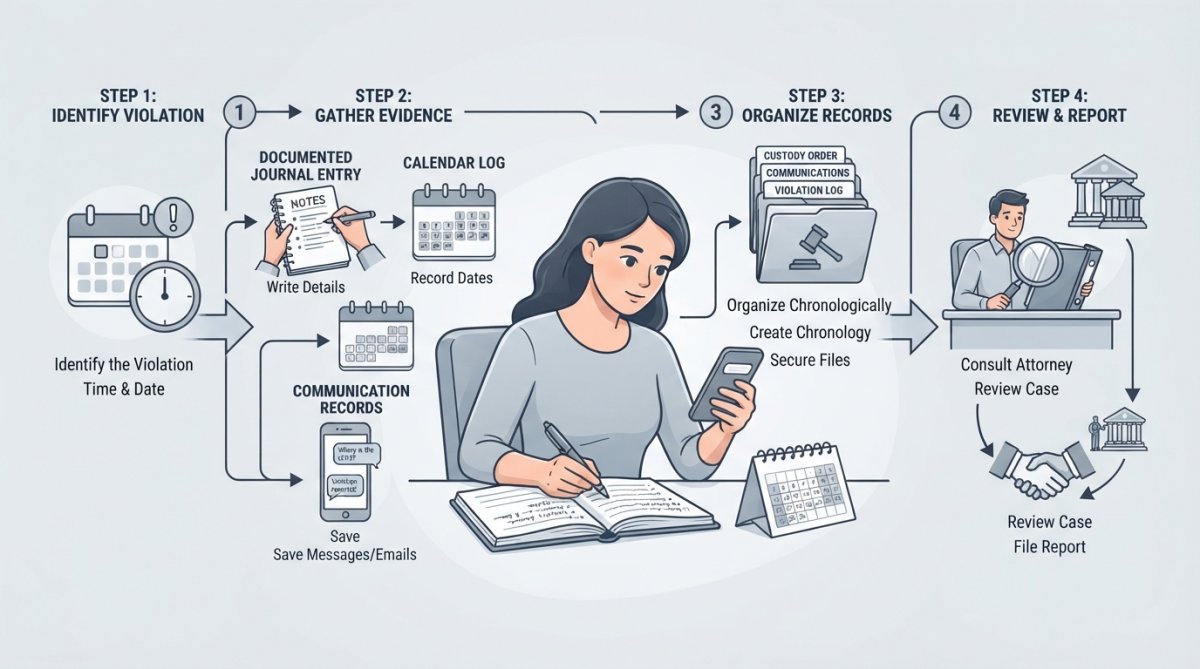
Photos and videos help. Keep files organized by date in a labeled folder for easy retrieval.
Emergency vs. Non-Emergency Violations
Not all violations are equal. Some demand immediate action; others can wait for a scheduled hearing. Understanding the difference determines your response.
Emergency violations require urgent intervention:
- A parent takes the child and refuses to return them (parental abduction or custodial interference)
- A parent threatens harm to the child or violates a domestic violence protective order
- A child is in immediate danger due to the violation (exposure to drugs, abuse, unsafe conditions)
- A parent violates a no-contact order or restraining order involving the child
- A parent attempts to flee the state with the child
What to do in an emergency:
-
Call law enforcement immediately to recover the child, ensure safety, or document the violation.
-
Contact your lawyer right away to file an emergency motion for temporary custody or a restraining order.
-
File an emergency ex-parte motion (heard without the other parent present) so the judge can issue immediate protective orders.
-
Preserve evidence with photos, videos, or written notes of the situation and any threats.
Non-emergency violations include:
- Late pickups or dropoffs (even repeated ones)
- Missed phone calls or video chats
- Failure to pay support on time
- Minor schedule changes without permission
- Refusing to enroll the child in agreed-upon activities
- Violating restrictions on where the child can travel (but not fleeing the state)
These still matter and should be documented. But they don't require calling 911. Instead, gather evidence over time and prepare to address them in court through a formal motion for contempt or enforcement.
Emergency motions move faster (hours or days vs. weeks or months). Emergency orders are temporary until a full hearing where both parents present evidence.
The distinction affects your entire strategy. Emergency situations demand immediate action and sometimes police involvement. Non-emergency violations build a case you present to the judge later through standard court procedures.
Filing for Contempt of Court in Custody Cases
Filing for contempt of court means the other parent deliberately violated the court's order. The process: gather evidence, consult a lawyer, file the motion, serve the other parent, attend the hearing, and await the judge's decision on penalties.
Filing a Motion to Enforce the Custody Order
Filing a motion to enforce focuses on compliance rather than punishment. Document violations, consult your attorney, file the motion, serve notice, and prepare for the hearing. If the judge agrees, they order compliance; failure to comply can lead to contempt charges.
Court-Ordered Penalties and Remedies
When a judge finds a violation, penalties may include fines, makeup visitation, supervised visitation, parenting classes, modified custody, attorney's fees, or in extreme cases, jail time.
How Custody Violations Affect Future Modifications
Violations create a permanent record that judges review in future modification cases. A pattern significantly influences outcomes.
The psychological impact on your child during enforcement:
How violations harm children:
-
Instability and anxiety. When a parent violates the custody order, the child experiences unpredictability. They don't know if they'll see the other parent as promised. This creates anxiety and erodes trust in both parents.
-
Loyalty conflicts. Children often blame themselves or feel caught between parents. If one parent is violating the order, the child may feel obligated to defend that parent or may resent them for causing legal conflict.
-
Interrupted bonding. When visitation is denied or delayed, the child loses time with the other parent. This disrupts the parent-child relationship and can cause long-term emotional damage, especially if violations are repeated.
-
Exposure to conflict. Court proceedings, emergency motions, and enforcement hearings expose children to adult conflict. Even if the child doesn't attend court, they sense the tension and may blame themselves for the family's legal problems.
How to minimize trauma during the enforcement process:
-
Shield the child from legal details. Don't discuss the violation, the motion, or the court case with your child. Keep legal matters between you and your attorney. Children should not feel responsible for the enforcement action.
-
Maintain stability in the child's routine. Even as you pursue legal remedies, keep the child's schedule, school, activities, and friendships as consistent as possible. Stability is a buffer against the stress of family conflict.
-
Avoid badmouthing the other parent. Even if the other parent violated the order, speaking negatively about them to your child damages the child's relationship with that parent and increases the child's emotional distress. Courts also view parental alienation negatively.
-
Prioritize the child's relationship with both parents. The goal of enforcement is compliance, not punishment. Once the court orders the other parent to comply, support that parent's relationship with the child. If the violation was resolved, move forward without ongoing resentment.
-
Consider counseling for your child. If the violation caused significant disruption (like a missed holiday or extended separation), a family therapist can help the child process the experience and rebuild trust.
-
Document the impact on the child, not just the violation. When you file a motion, include how the violation affected your child emotionally and developmentally. Judges consider the child's wellbeing, and evidence of psychological impact strengthens your case.
How violations affect support arrangements:
Steps to Take Before Filing Legal Action
Before you file a motion in court, consider these steps. They might resolve the issue without litigation, and they show the court you tried to handle things reasonably.
1. Review the custody order carefully
2. Document everything
3. Send a written reminder
4. Try direct communication
5. Consider mediation
6. Consult a family law attorney
7. Know when to file
Frequently Asked Questions
What happens if a parent violates a custody order in Maryland?
When a parent violates a custody order, the custodial parent can file a motion for contempt of court or a motion to enforce. The court may impose sanctions, including fines, makeup visitation time, parenting courses, or in serious cases, modification of custody. The court prioritizes the child's best interest when determining penalties. Legal remedies depend on the severity and frequency of violations.
How do I file for contempt of court for a custody violation in Maryland?
To file for contempt of court, you must first document all violations with dates, times, and details. File a motion with the family court in the county where the custody order was issued. Include your evidence and explain how the other parent violated the order. You may need to attend a hearing where you present your case. Consider consulting with a family law attorney to ensure proper filing and representation.
What evidence do I need to prove a custody violation?
Gather documentation including written communications (texts, emails), calendar records showing missed visitation, witness statements, photographs, and police reports if applicable. Keep a detailed log with dates, times, and descriptions of each violation. School or daycare records can support claims about unauthorized changes to schedules. The more specific and organized your evidence, the stronger your case when filing a motion to enforce.
Can violations affect future custody modifications in Maryland?
Yes. A history of custody order violations significantly influences how courts view future modification requests. Repeated violations demonstrate a pattern of non-compliance and disregard for the child's best interest, which courts consider when deciding custody changes. If you're the violating parent, modifications are less likely in your favor. If the other parent is violating, documented violations strengthen your position in any modification proceeding.
Custody violations are serious, but you have legal remedies. The key is documenting everything, understanding your options, and acting strategically. Whether you need to file for contempt, enforce the order, or modify custody, professional legal guidance makes the difference. Contact The Law Office of Thomas K. Mallon, LLC for a free consultation to discuss your situation and learn how we can help protect your rights and your child's best interests.